Dog beds get complicated surprisingly fast.
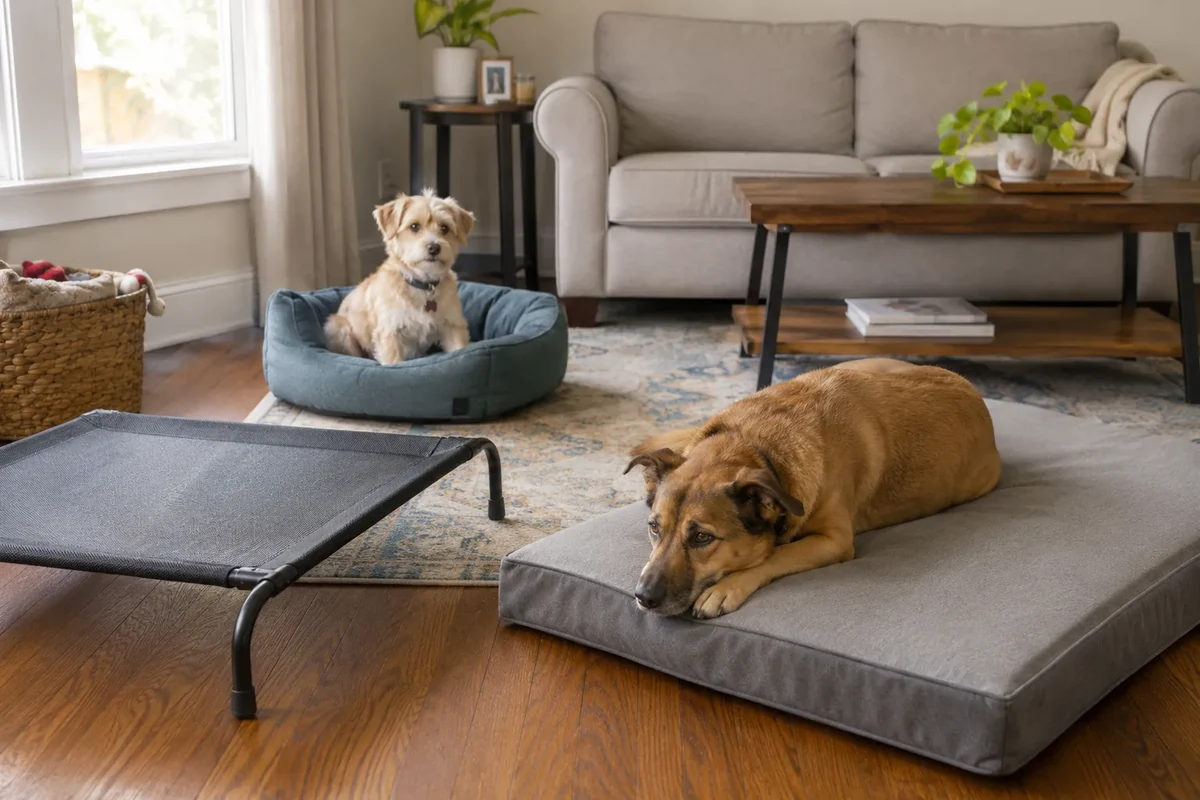
One is basically a giant pillow. Another has walls around it. Some are made from thick foam, some look more like camping cots, and others have a blanket sewn right over the top.
Dogs can have opinions about all of them.
The easiest place to start is not with the marketing on the package. Look at how your dog already sleeps. A dog that stretches across half the living room may want something very different from one that disappears under the comforter every night.
Size matters too. So do age, mobility, coat, and the amount of cleaning you're willing to do.
Here are five common styles you'll run into in U.S. pet stores and online.
| Bed style | Worth considering for |
|---|---|
| Flat or pillow bed | Dogs that like to stretch out |
| Bolster bed | Dogs that curl up or rest against an edge |
| Orthopedic foam bed | Older dogs or dogs that need more support |
| Elevated cot | Airflow, porches, patios, easy surface cleaning |
| Cave or covered bed | Dogs that like burrowing under blankets |
1. Flat and Pillow Beds
This is the basic dog bed most people picture first: a padded rectangle, oval, or round cushion with no raised sides.
There is nothing fancy about it, which is partly why it works.
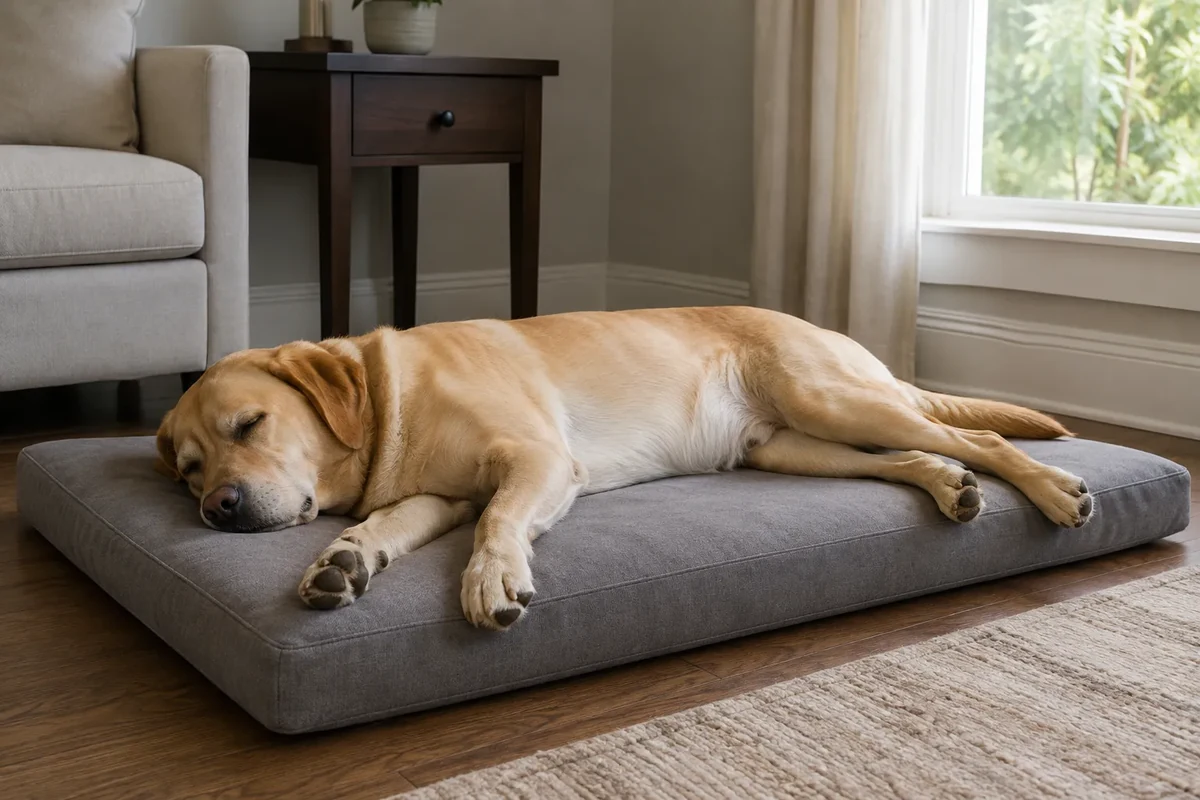
A flat bed gives a dog plenty of freedom to change positions. A Lab can sleep on its side with all four legs pointing in different directions. A smaller dog can curl up in the middle. There is no wall deciding where the head or feet should go.
The big thing to watch is size.
A bed can look enormous in the store and become surprisingly small once a 70-pound dog lies down on it. If your dog normally sleeps stretched out, measure roughly how much room that actually takes rather than buying by the words “large” or “XL” alone.
Also pay attention to what is inside. Some inexpensive stuffed beds stay comfortable for a long time; others lose their shape fairly quickly. A removable, machine-washable cover is a nice feature in a home where muddy paws and shed hair are normal events.
2. Bolster and Donut Beds
Bolster beds add raised sides. Some have three sides and an open front. Others are round, with a soft rim all the way around.
These tend to make sense for dogs that like having something beside them while they sleep.
Think about the dog that always puts its chin on the arm of the couch, curls up against a pillow, or wedges itself into the corner of a chair even though there is an entire empty cushion available.
That dog may appreciate a bolster.
The sides do take away some sleeping space, though. A bed advertised for a medium dog may have a fairly small usable center once you subtract the thick outer rim.
For an older dog, I also prefer a design with a lower opening rather than a tall wall around the entire bed. Stepping over a big padded edge gets less charming when hips and knees are not as flexible as they used to be.
3. Orthopedic and Memory-Foam Beds
The word orthopedic gets attached to a lot of pet beds, so it is worth looking past the label.
What you really want to know is what the dog is lying on.
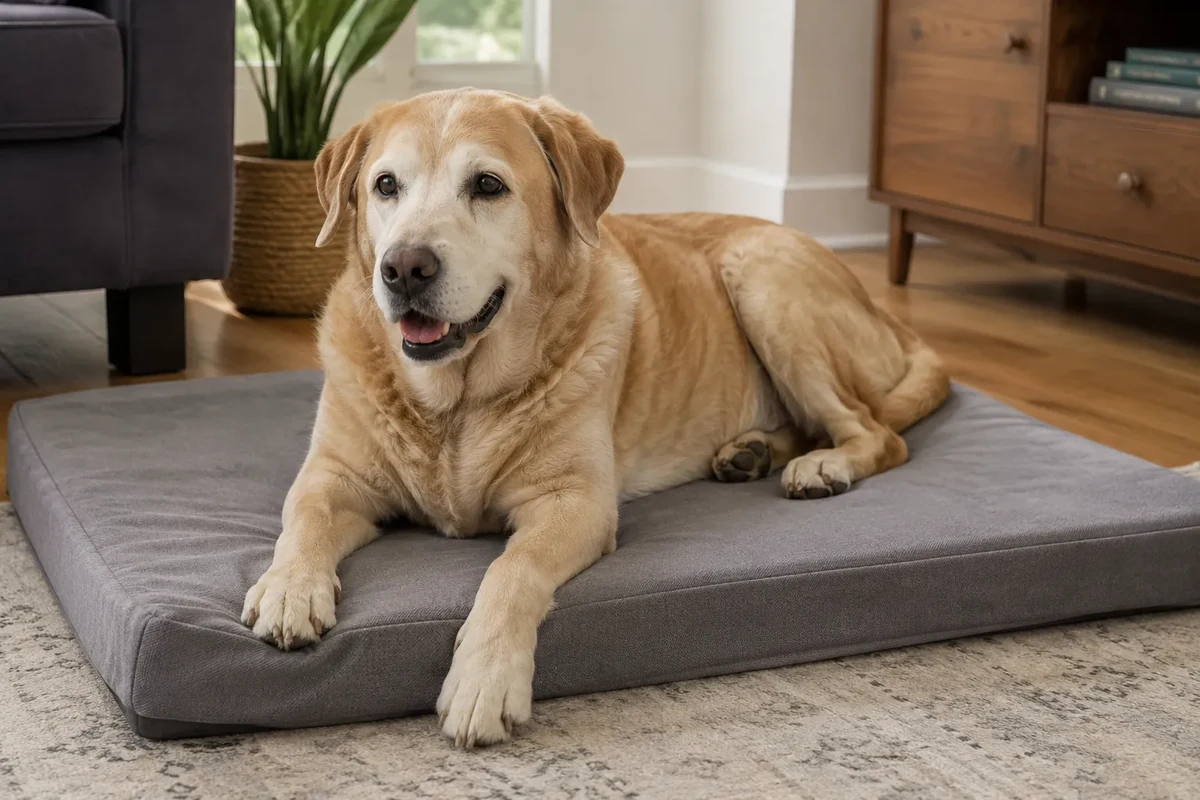
A supportive foam bed should have enough depth that a dog's heavier points — hips, shoulders, elbows — are not simply pressing through to the floor underneath. That becomes more relevant with older dogs, large breeds, and dogs that are uncomfortable on thin bedding.
Memory foam is one option. It is not magic, and it does not last forever. Foam quality and thickness vary a lot from bed to bed.
For a senior dog, the shape may matter just as much as the foam. A low bed that is easy to step onto can be much more practical than a beautifully padded bed surrounded by a tall rim.
And if your dog has arthritis, pain, weakness, or trouble getting comfortable, a bed can help make resting easier, but it is not a replacement for veterinary care.
4. Elevated Dog Cots
An elevated cot looks less cozy than a pile of cushions, but some dogs absolutely prefer one.
Instead of sitting directly on the floor, the sleeping surface is stretched over a low frame. Air can move underneath, which can be nice in a warm house or on a covered porch during mild weather.
They are also practical.
There is no deep pile of stuffing collecting hair. Many cot-style beds can be wiped down more easily than a thick fabric bed, and some models are made for indoor and outdoor use.
That does not mean every elevated bed belongs outside or can be blasted with a garden hose. Check the materials and cleaning instructions for the particular model.
The other consideration is getting on and off.
A low cot may be perfectly comfortable for one senior dog and annoying for another. If a dog already has mobility problems, stability and step height matter more than how tidy the bed looks in the living room.
5. Cave and Covered Beds
Some dogs sleep on top of the blanket.
Others spend ten minutes rearranging it and then vanish underneath.
Cave beds are made for the second group.
They usually have a soft sleeping surface with a fabric hood or attached cover that creates a more enclosed space. Small dogs often get associated with this style, but size is not really the deciding factor. The better clue is whether your dog already likes burrowing into bedding.
Covered beds also tend to hold more warmth than open beds.
That can be pleasant for a short-coated dog in a cool room and completely unappealing to a dog that already leaves every soft bed to sleep on the tile.
Cleaning is worth checking before buying. A cave bed with a permanently attached padded cover may be much more annoying to wash than one with removable pieces.
And yes, eventually there will probably be hair inside the cave too.
The Bed Label Matters Less Than the Dog
You do not really need to identify your dog's official “sleep personality.”
Just watch what happens when nobody is trying to influence the answer.
Does the dog stretch out on the floor?
Curl tightly against the couch?
Use a pillow as a headrest?
Leave the fluffy bed to sleep somewhere cooler?
Crawl under every blanket in reach?
Those habits tell you quite a bit.
Then look at the less interesting details that become very important after you own the bed.
Can the dog fit on it comfortably? A sleeping surface should give the dog enough room to use its normal positions.
Can the dog get onto it easily? Senior dogs and dogs with limited mobility may do better with a lower entry.
Can you clean it without turning laundry day into a project? In a pet household, washable covers are hard to regret.
If loose hair is the bigger household problem, our Pet Hair Cleaning Guides cover floors, rugs, furniture, and the awkward places fur collects.
Does it slide around? A nonslip bottom can be useful on hardwood, tile, and other smooth floors.
Is your dog likely to destroy it? A dog that tears apart soft bedding may need a simpler, tougher setup rather than an expensive cushion filled with foam pieces.
What About Crate Beds?
A crate pad is really more about shape and fit than a separate type of bed.
If you use bedding inside a crate, it should fit without bunching up and should not reduce the usable space so much that the dog cannot lie comfortably.
Puppies and dogs that chew bedding are a different story. A thick foam mattress is not very useful if the dog immediately opens it and starts eating the filling.
Sometimes the simpler option is the better one until that phase passes.
Do Older Dogs Always Need an Orthopedic Bed?
Not necessarily.
A supportive bed can be a good upgrade for an older dog, but the word orthopedic on a product page does not tell you whether your particular dog will like it.
Some senior dogs want thick foam. Some prefer a firmer surface. Others care more about being able to step onto the bed without climbing over anything.
If your dog keeps leaving a new bed to sleep somewhere else, that is useful information.
The expensive bed does not get an automatic vote.
So Which Dog Bed Should You Buy?
Start with the dog, not the bed category.
A sprawler may be happiest on a wide flat cushion. A dog that always uses the couch arm as a pillow may enjoy a bolster. An older large dog may appreciate a supportive low-profile foam bed. A dog that seeks cooler surfaces might like an elevated cot. A dedicated blanket burrower is an obvious candidate for a cave bed.
Then check the boring stuff: dimensions, washability, entry height, construction, and whether it will survive normal life in your house.
You may still buy a beautiful new bed and discover your dog asleep beside it on the floor.
Dogs are helpful like that.